Faceless YouTube Channel Ideas: Real Demand
Is the sleep history niche saturated? Is finance stickman the highest-RPM niche? Is it too late to start a psychology channel?
People get stuck in these loops because they are looking at YouTube through the wrong lens. There is no secret, undiscovered golden niche waiting for someone to notice it. And I do not really choose a niche. I choose an audience.
You are not choosing a niche, you are choosing an audience
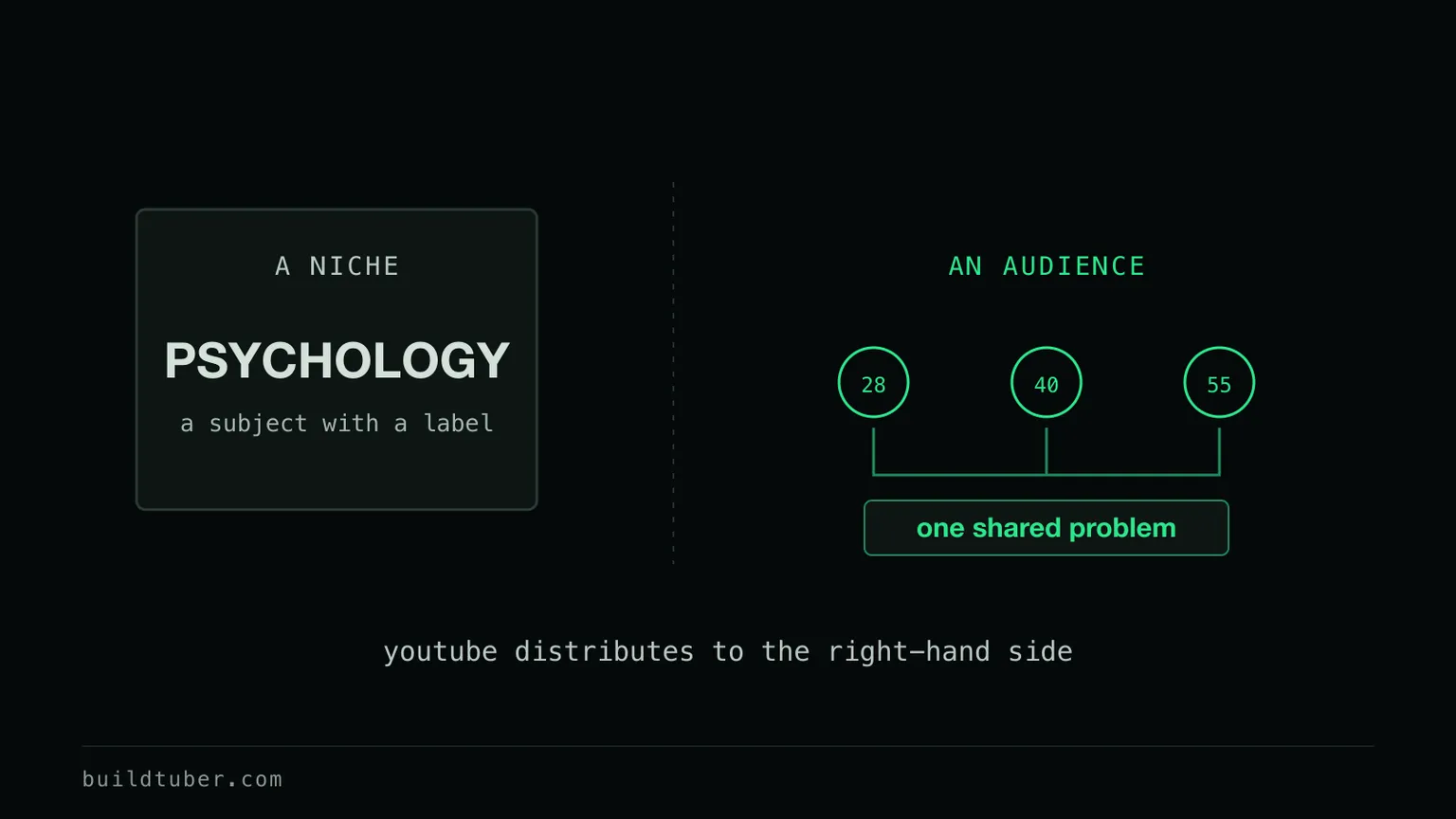
Unlike Reddit, which sorts people into clearly labelled communities, YouTube has no psychology box, no history box and no finance box that it distributes videos into. It studies viewer behaviour, then groups together people who repeatedly click, watch and enjoy similar content. At its core it is matching audience demand with creator supply: working out which viewers are likely to enjoy a particular video, then testing that video on more people who behave like them.
So the real question is not which niche should I enter. It is: which audience do I understand well enough to satisfy again and again?
Psychology is a niche. People who overthink every interaction, feel emotionally exhausted, and want to understand the hidden mechanisms driving their own behaviour. That is an audience. It might contain a 28-year-old in a corporate job, a 40-year-old running a business and a 55-year-old retired lawyer. The demographics differ. The emotional problem connecting them does not.
What “niche down” actually means
It does not necessarily mean picking a smaller subject. It means making several videos that satisfy the same audience hunger, so that both viewers and YouTube can work out who the channel is for.
Once you understand that, the next question is not whether the niche is crowded. It is whether you have enough unfair advantages to compete inside it.
The five unfair advantages
1. Proven Audience Demand
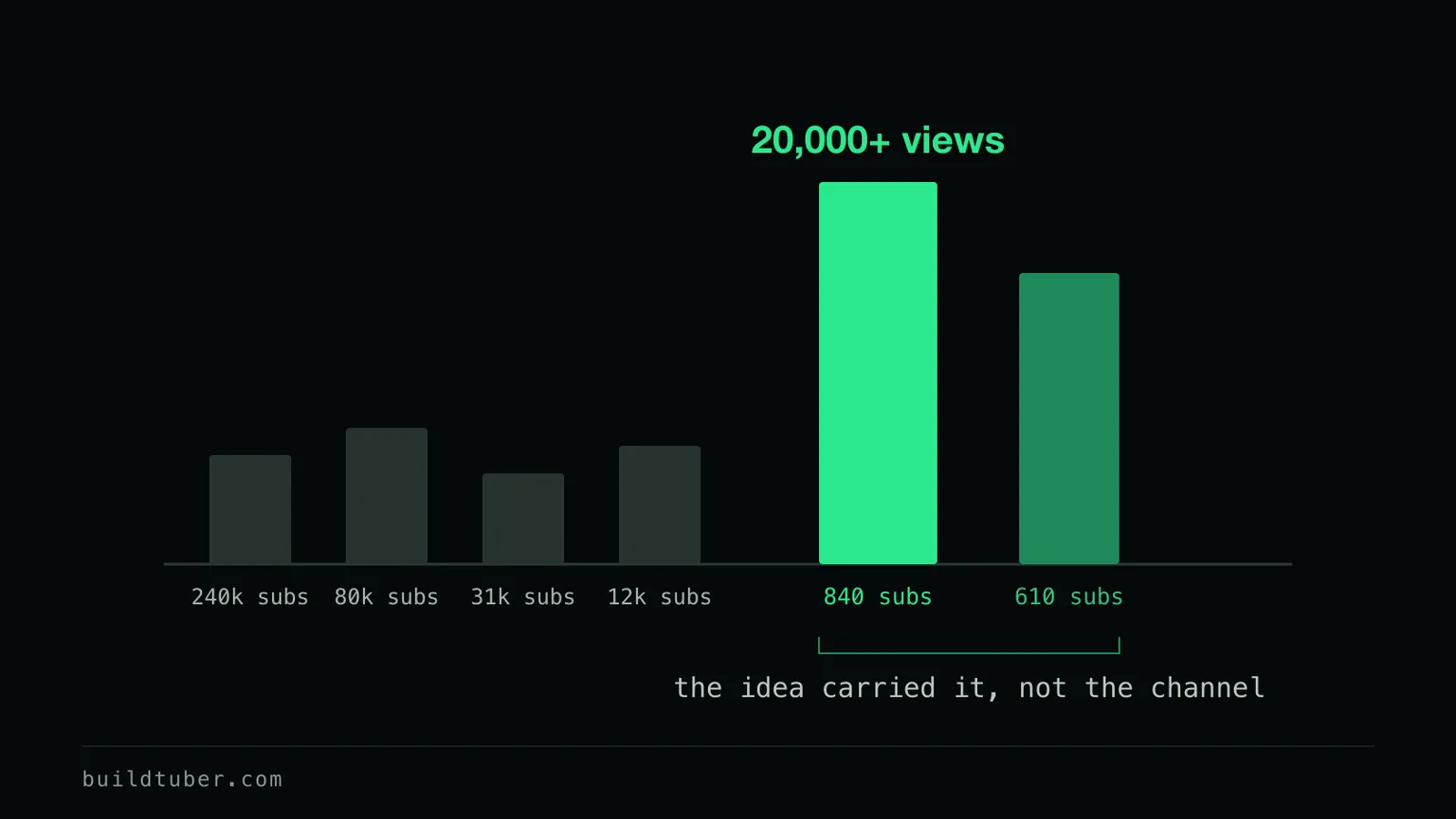
Look for evidence. Are several new channels getting views in the space? Do similar topics repeatedly become outliers? Are small channels pulling unusually large view counts on specific videos?
One of the strongest signals is a channel with fewer than 1,000 subscribers receiving 20,000 or more views on a few uploads. That tells you viewers are willing to watch the idea without needing an established creator behind it.
You are not looking for zero competition. Zero competition usually means zero demand. You are looking for visible demand with imperfect supply.
Ancient humanity told through 2D stickman scenes is working well at the moment. Ancient humanity is the subject, people fascinated by the missing parts of human history are the audience, and stickman scenes are only the format. The format works because it gives an existing audience a fresh way to consume questions they already care about. Entering early is a real advantage: proven demand, still thin supply.
That advantage rarely lasts on its own. Once a format starts working, other creators copy the titles, thumbnails and visual style very quickly. The audience stays strong but the supply turns repetitive. If being early was your only advantage, you will eventually be outcompeted by people who arrived later with more of the advantages below. A fresh format gets you into an audience. The rest of this list decides whether you stay.
2. Deep Interest or Real Experience
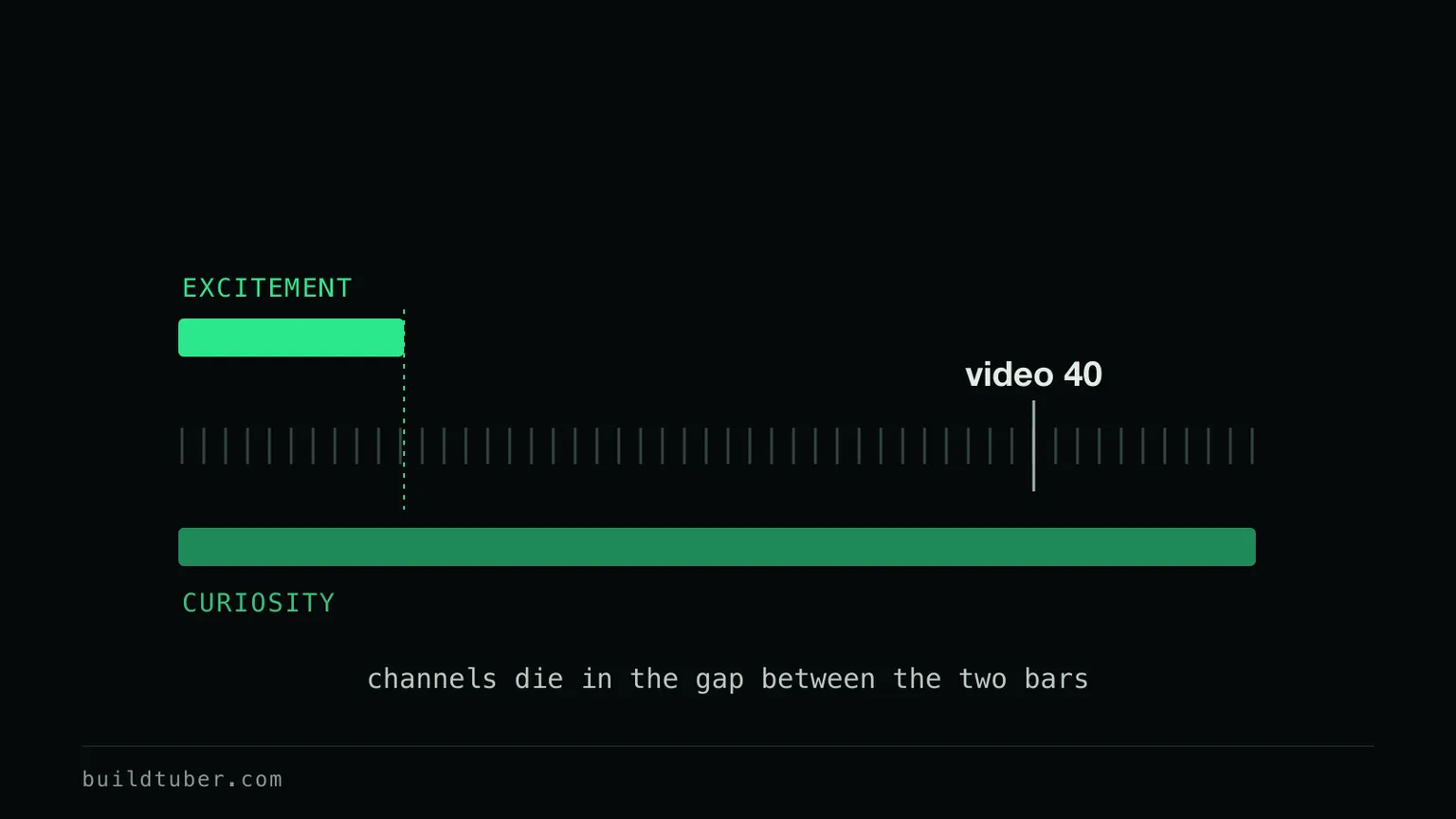
Can you comfortably research, write and produce 50 to 100 videos on this subject without running out of curiosity?
Most channels do not fail because the creator could not come up with the first ten titles. Those get copied from outliers or generated in an afternoon. They fail when the initial excitement wears off, the views are still low, and the creator realises they do not enjoy the subject enough to keep going. Strong channels are built around audiences with several emotional branches, so you can explore different questions, conflicts, desires, fears and outcomes without ever leaving the same core viewer.
Someone with genuine interest asks better questions. They know the audience’s language. They can tell when an AI-generated script is shallow, repetitive or simply wrong.
A high-RPM finance topic you hate is usually a worse choice than a lower-RPM topic you can obsess over for years.
3. A Format or Packaging Advantage
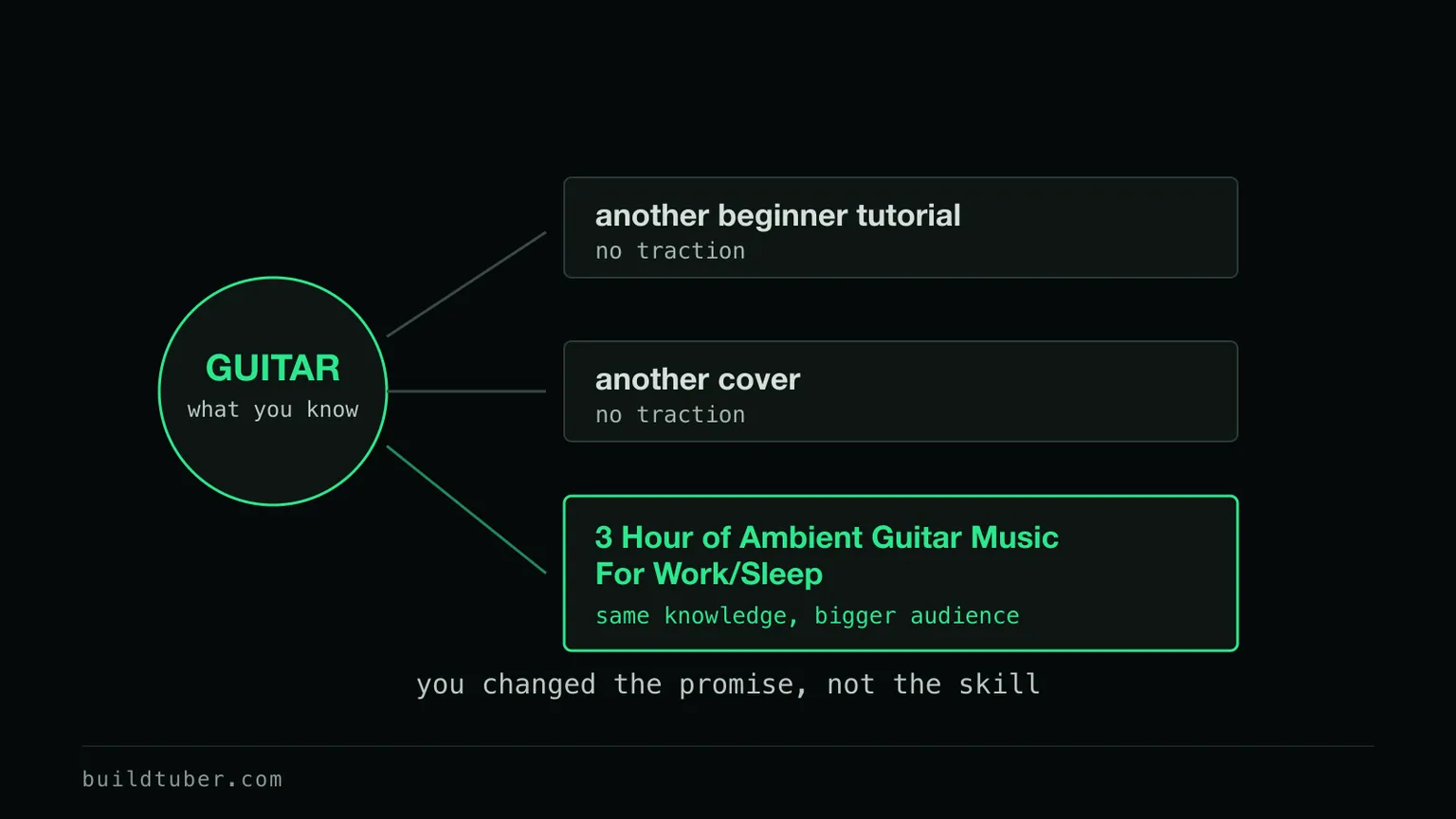
Why should someone watch your version instead of the fifty that already exist? Sometimes the answer is the format rather than the subject.
Say you love playing and teaching guitar, but generic tutorials and covers get almost no traction. You do not have to abandon what you know. You can attach that knowledge to a stronger adjacent audience. Instead of basic lessons, make videos about why certain popular songs are emotionally powerful. Instead of another cover, produce two hours of ambient guitar for studying or sleeping. You keep the knowledge advantage and change the promise you are making to the viewer.
The format does not have to be original. It only has to feel meaningfully different from what that audience has already consumed repeatedly. Sometimes the subject is still strong and it is the dominant format that has gone stale. That is a better opportunity than trying to invent a topic nobody has ever covered.
4. Pattern Recognition and Learning Speed
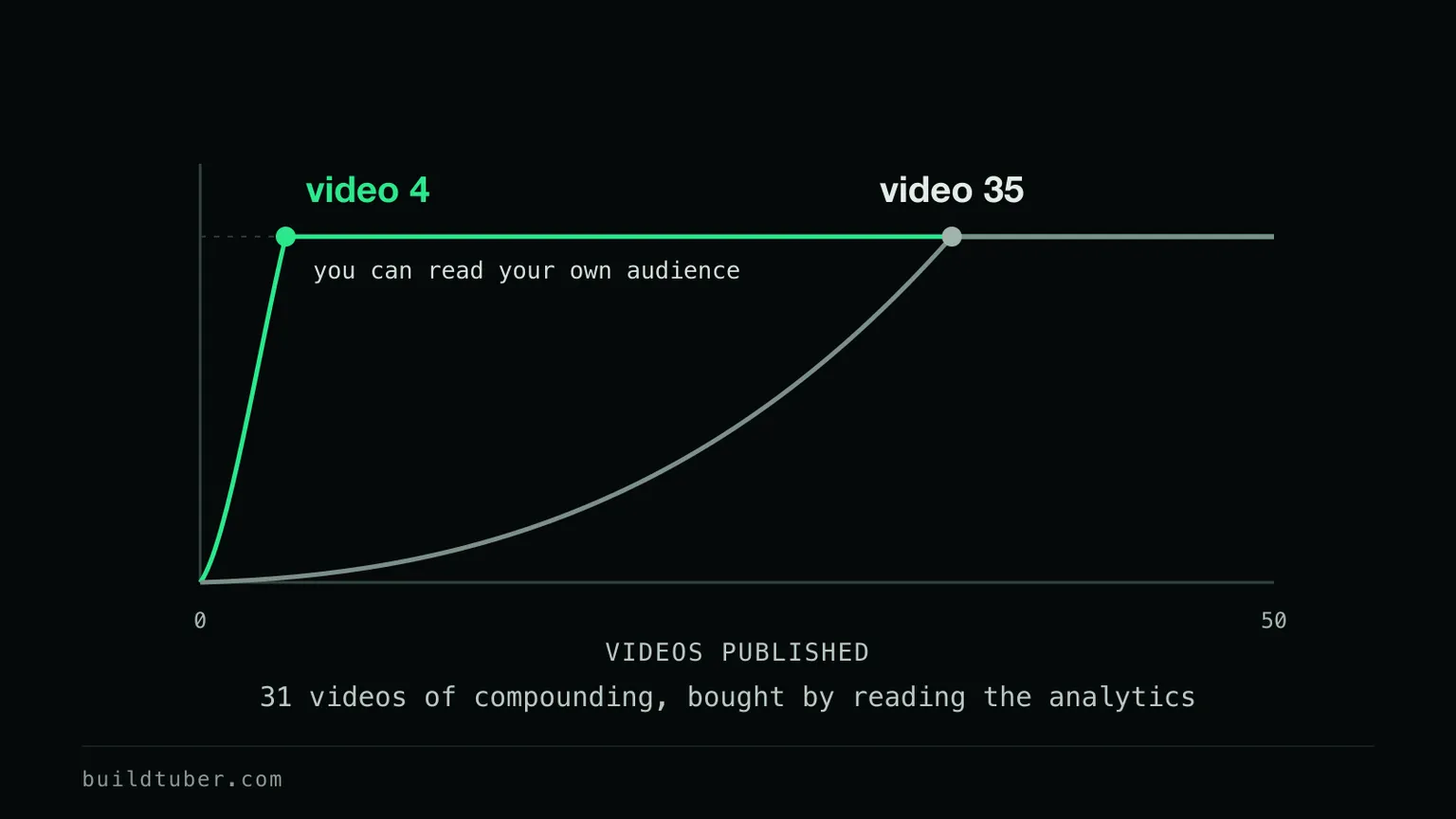
Can you look at your analytics and understand why viewers clicked, where they stopped watching, and which videos brought them back? Can you work out why a video failed instead of blaming the algorithm? Can you spot which ideas repeatedly become outliers on your own channel?
Most new creators need 30 to 40 videos before they can read their audience. Someone with strong pattern recognition gets there in three to five.
That gap is worth more than any niche choice, because it compounds. Everything you learn on video four is applied to videos five through fifty.
5. Production Cost and Runway
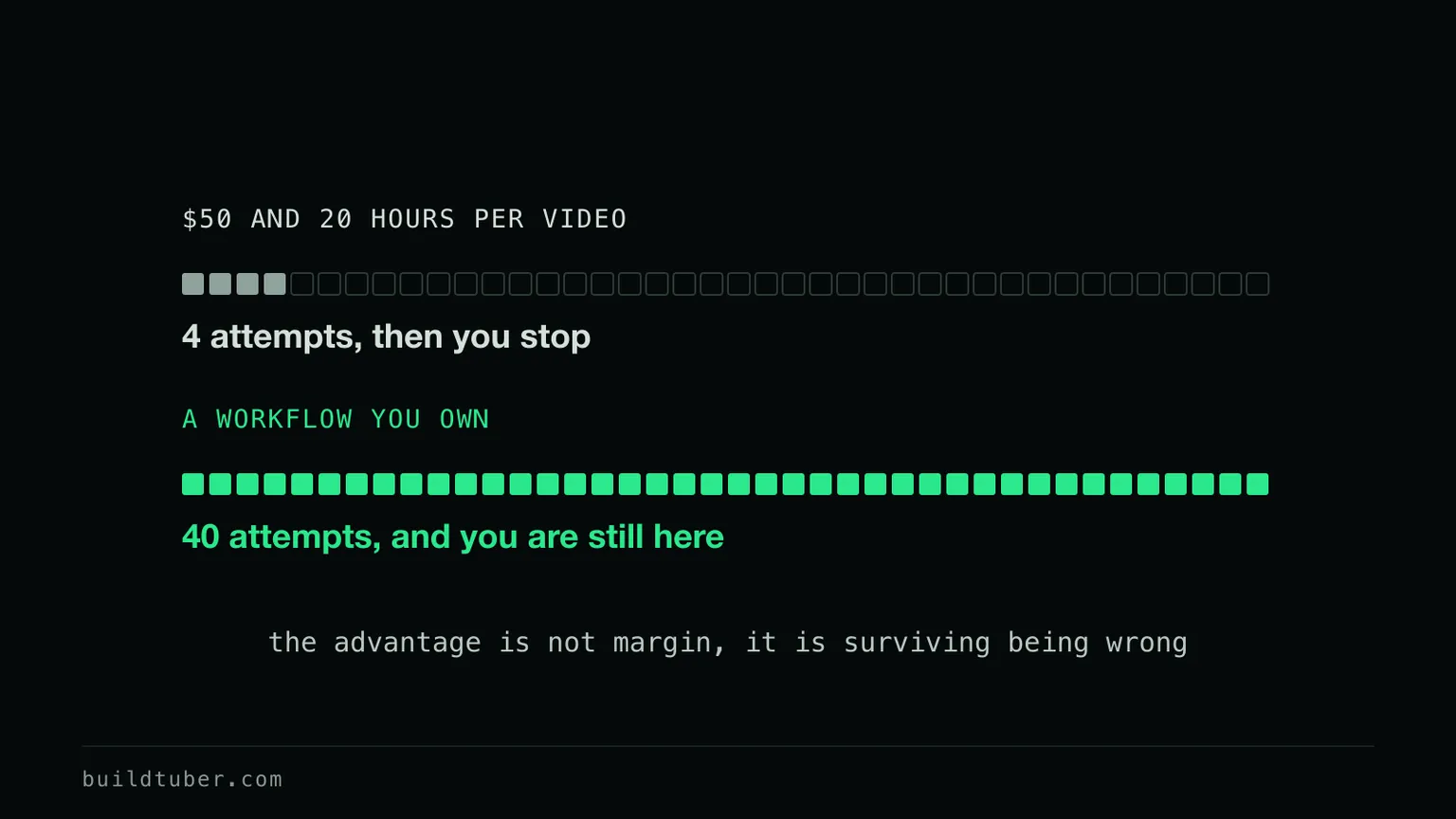
How much does each experiment cost you, in time and in money?
If every video needs $50 of AI credits and 20 hours of manual editing, you may run out of money or energy before YouTube has worked out who wants your content. A cheaper workflow buys you more attempts. That does not mean publishing low-quality videos endlessly. It means you can test more topics, titles, thumbnails, hooks and formats without every failure hurting.
The real advantage of low production cost is not a better margin. It is the ability to survive being wrong 40 or 50 times. This is most of the reason I care about owning the stack rather than renting it.
Can AI find you a niche?
Partly, and not in the way most people try to use it.
Ask a model for faceless channel ideas and you get the same widely circulated list everyone else is getting, which is close to useless. By the time an idea is common enough to be in the training data, the supply problem is already solved. What AI is genuinely good at here is the legwork underneath the judgement: summarising what competing videos actually cover, pulling the recurring complaints out of a few hundred comments, drafting the questions an audience keeps asking, and helping you organise the research you have already gathered.
It cannot manufacture demand. It has not watched your analytics. The decision about which audience you can serve repeatedly is still yours, and it is the one decision that matters most.
How I applied this to my own channel
I chose to serve faceless creators who want better videos at the lowest possible cost, treating AI as a useful production tool rather than a one-click machine that thinks for you.
The demand was already visible, and the problems are ones I understand deeply from running into them: scripting, production costs, visuals, and the limits of tools that promise a finished video from a prompt.
That gives me most of the advantages above on the channel: a subject I can talk about for years, a format I enjoy, real operating experience, and a way of making money that connects naturally to the content instead of sitting awkwardly beside it.
So where does that leave you?
There is no universally perfect niche. There is only a niche where your interests, skills, resources and audience demand overlap strongly enough to give you an advantage over the average person entering it. The more of the five you hold, the better your odds.
If you are still stuck on whether a space is too crowded, you are asking a question that has no useful answer. Ask instead which of the five you already have, and which one you could realistically build. Then go and start the channel.
Frequently asked questions
Is the faceless YouTube niche I want already saturated?
Almost certainly, in the sense that someone is already making videos about it. That is usually a good sign rather than a bad one. Zero competition normally means zero demand. What you are looking for is visible demand with imperfect supply: an audience that clearly wants the subject, being served by videos you can beat.
What is the difference between a niche and an audience?
A niche is a subject. An audience is a group of people connected by a problem, a curiosity or a feeling. Psychology is a niche. People who overthink every interaction and want to understand what is driving their own behaviour are an audience. YouTube distributes to the second thing, not the first.
How do I know if a niche has real demand?
Look for evidence rather than opinion. Are new channels getting views in the space? Do the same topics repeatedly become outliers? The strongest single signal is a channel with fewer than 1,000 subscribers pulling 20,000 or more views on several uploads, because it shows viewers will watch the idea without an established creator attached to it.
Should I pick a high-RPM niche even if I am not interested in it?
Usually not. A high-RPM subject you dislike is often a worse choice than a lower-RPM subject you can stay curious about for years, because most channels do not die from a bad first ten videos. They die when the early excitement runs out, the views are still low, and the creator has no appetite left for video forty.
Can AI pick a niche for me?
It can speed up the research and help you organise what you find, but it cannot manufacture demand and it has not watched your analytics. Ask it for niche ideas and you get the same widely repeated list everyone else is getting. The judgement about which audience you can serve repeatedly is still yours.
How many videos does it take to know whether a niche is working?
Most new creators need 30 to 40 videos before they can read their own audience with any confidence. Someone with strong pattern recognition can get there in three to five, because they are actually reading the analytics rather than waiting for a result to feel obvious.
Related guides
- YouTube Growth6 min read
Why YouTube Automation Doesn't Work in 2026 (and What Actually Works)
YouTube automation is easier than ever in 2026, but production is no longer the advantage. Here is what actually matters for a faceless YouTube channel now.
- YouTube Growth7 min read
How to Start a Faceless YouTube Channel in 2026
After 1000+ published videos, the order I would actually follow: niche first, then ideas, packaging, script, voiceover, visuals and the edit.
- AI Tools & Workflow7 min read
AI YouTube Script Writer: The Five Levels
AI is a poor scriptwriter and a strong assistant. The five levels of using an AI YouTube script writer, from rewriting transcripts to writing it yourself.
Get the build guides as they go out.
One email when a new guide ships. The full method, not a teaser. Unsubscribe whenever.