AI YouTube Script Writer: The Five Levels
AI is a terrible scriptwriter.
It is an excellent writing assistant, but left on its own it produces bland hooks, predictable storytelling and scripts nobody remembers. It is like a race car. Put a beginner behind the wheel and they still finish last. Put a good writer behind the same model and the output looks like a different product.
The biggest lie in this corner of YouTube is that better prompts create better scripts. Better thinking creates better scripts. AI also cannot manufacture demand. It cannot take a boring topic and make millions of people suddenly care about it. Treat it as a multiplier: give it weak ideas, thin research and a vague instruction, and it will cheerfully produce a polished version of mediocrity. Give it a strong topic, a clear structure and real thinking, and it becomes unreasonably powerful.
Does the idea deserve a script at all?
Before any of the levels below matter, you need to know whether the video is worth writing. That comes down to pattern recognition at two scales.
Macro patterns are what the platform is rewarding across your niche: recurring topics, title formats, emotional angles, the ideas that keep turning into outliers.
Micro patterns are what your own data is telling you: which hooks held attention, where viewers left, which promises earned clicks, which videos brought people back.
The better you get at reading both, the less time you waste polishing excellent scripts for ideas that never had an audience waiting. Once the idea is strong, AI scriptwriting sorts into five levels.
Level 1 - The Rewriter
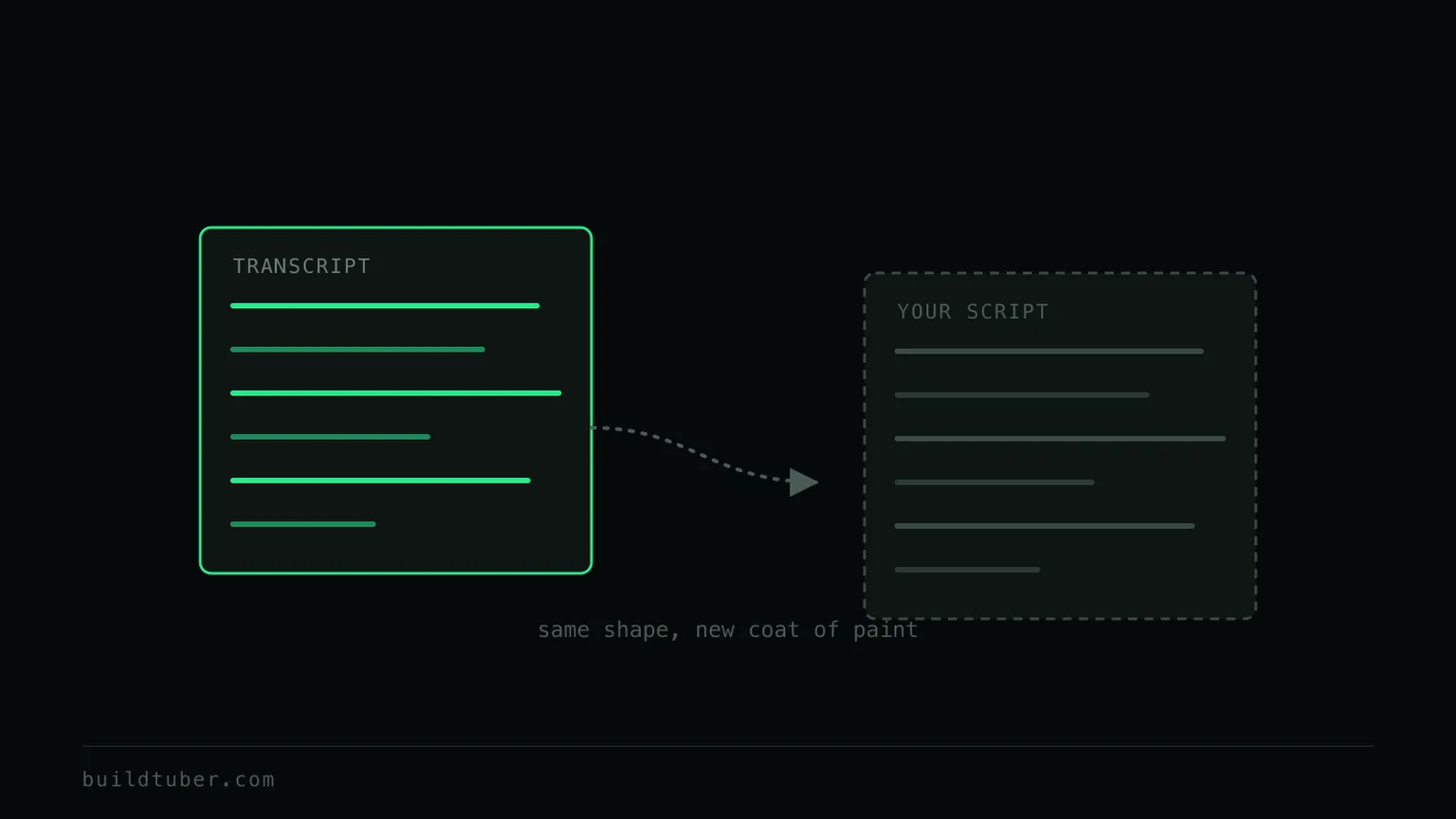
Almost everyone starts here, including me. You find an outlier in your niche, copy the transcript, paste it into Claude and ask it to rewrite the script without plagiarising. Maybe you change the title slightly, or ask for a more conversational tone.
If the original script was good, you will probably end up with something perfectly watchable. That is why so many channels start here and why it feels, briefly, like a solved problem.
The problem is that you are not learning to write scripts. You are learning to rewrite them. The model is doing all the thinking, and you are polishing someone else’s framework instead of building your own.
This is still the fastest way to understand what a good script actually looks like. Do it a few times deliberately, as study. Just do not build a channel on it. The point is to learn from good scripts, not to spend years rewriting them.
Level 2 - The Prompt Engineer
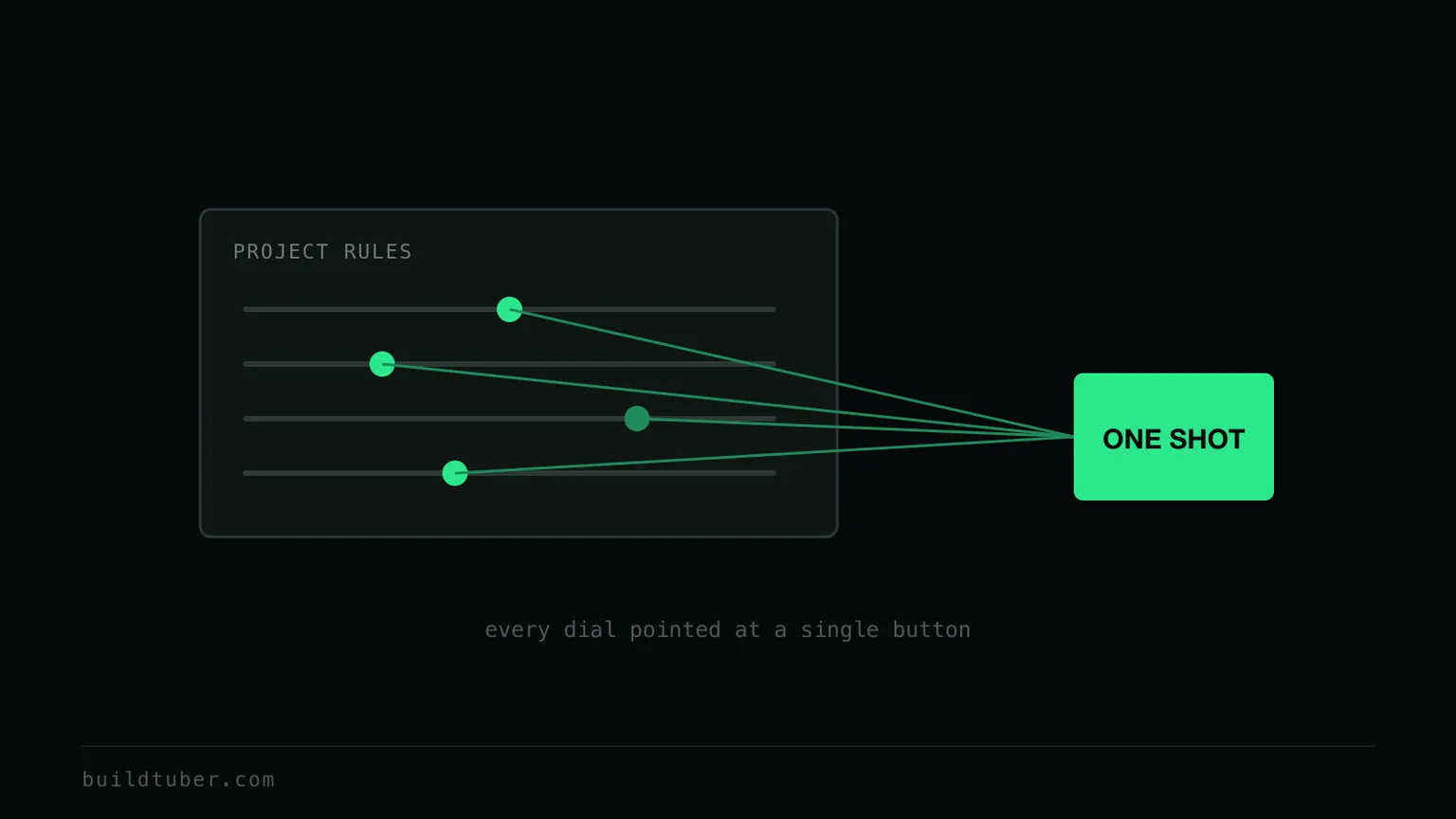
Instead of feeding the model someone else’s transcript, you start building your own environment around it. A Claude Project with a scriptwriting guide, examples of your previous scripts, custom instructions, writing rules, maybe a document defining the tone and world of the channel.
The output gets more consistent. Your scripts develop a recognisable voice. You spend less time fixing obvious mistakes. Most people stop here, because it feels like they have finally found the perfect prompt.
The problem is that you are still asking the model to solve the entire problem in one shot. You paste a title, add a few instructions, press enter, and expect it to work out the hook, the pacing, the chapter flow, the emotional arc, the examples and the ending on its own. Sometimes it does a surprisingly good job. Most of the time it does not.
This is the point where you stop optimising prompts and start designing the script before the model writes a single word.
Level 3 - The Director
This is roughly where a channel sits when it is consistently clearing 100 views, has four or five videos past 1,000, and maybe one breakout above 30,000. You are either just monetised or stuck short of the watch time or subscriber requirement. Volume matters less here than it did. If you are burning out, or convinced the algorithm has taken against you personally, it has not. But quality is now the constraint, not quantity.
Open a document. Answer these before you write anything:
- Who is this video for?
- Why would someone click it?
- What should they feel in the first thirty seconds?
- How do we exceed their expectations once they have clicked?
- How does the story end?
The model should not be making any of those decisions. You should.
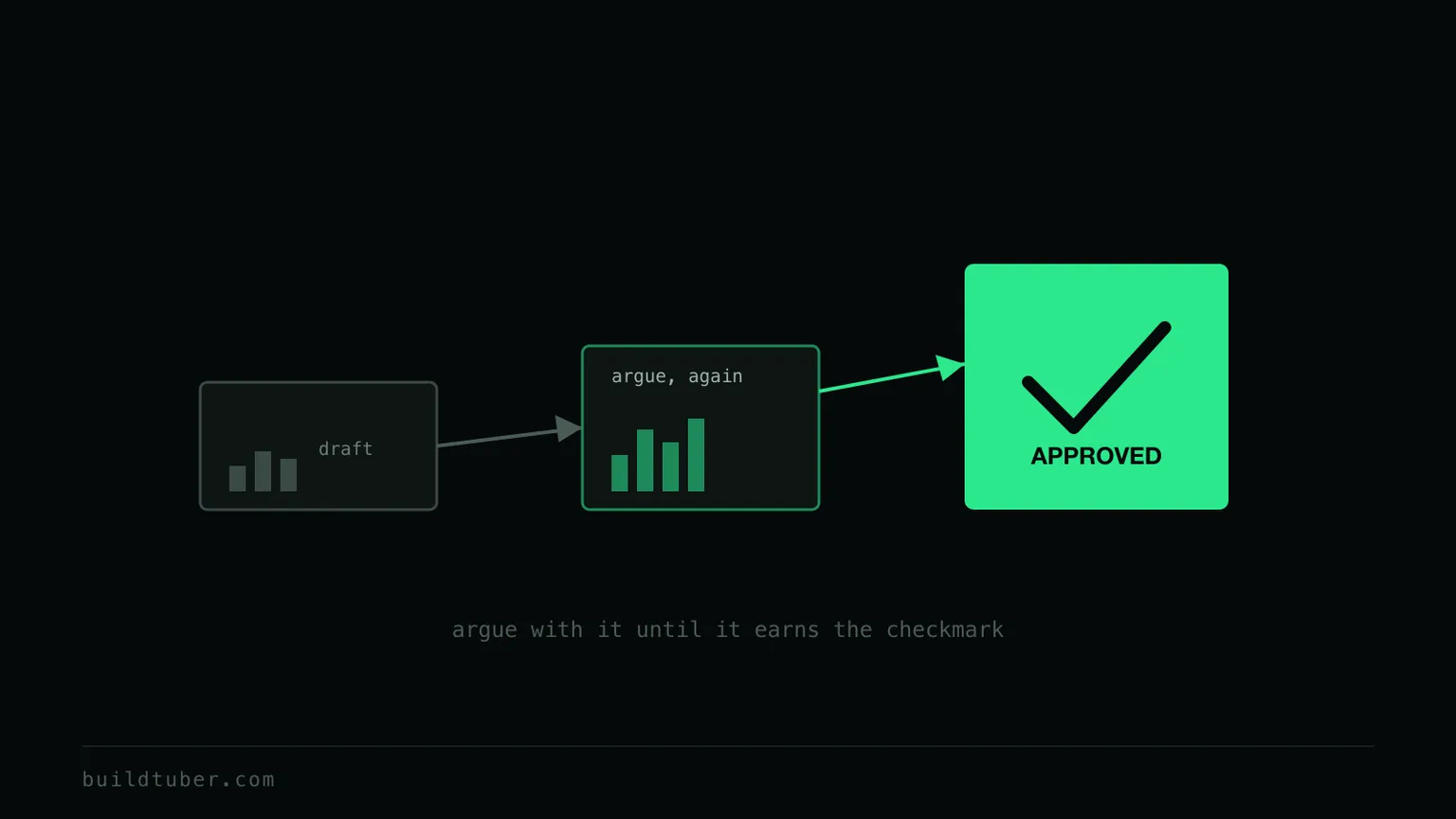
Then hand all of it over and write the hook first. Read it. Tell it what is wrong. Disagree with it. Argue until you are satisfied. Then move to the next section, then chapter one, then chapter two. You are teaching it, within that conversation, that generic is not acceptable here.
The obvious objection is that you cannot tell whether the draft is any good. That judgment comes with volume, and in the meantime you can borrow someone else’s: paste the section into a different model and ask it to tear the writing apart. A model has no loyalty to a draft it did not write.
Stop thinking of the model as a scriptwriter and start treating it as a junior writer sitting next to you. You decide what needs to be said. It helps you decide how to say it. That is the point where the output stops sounding like everyone else and starts sounding like your channel.
What changes when the script gets very long
Everything above assumes a script you can hold in one document and read in one sitting. Ultra long-form is a different game. Past roughly ten thousand words, writing section by section stops being a discipline you choose and becomes the only thing that works, because no single call holds the structure of an hour in its head. The judgment in this post still applies; the mechanics change. I wrote up how that runs section by section, and what it costs separately, and the script engine is that method already assembled into a sheet.
Level 4 - The Strategist
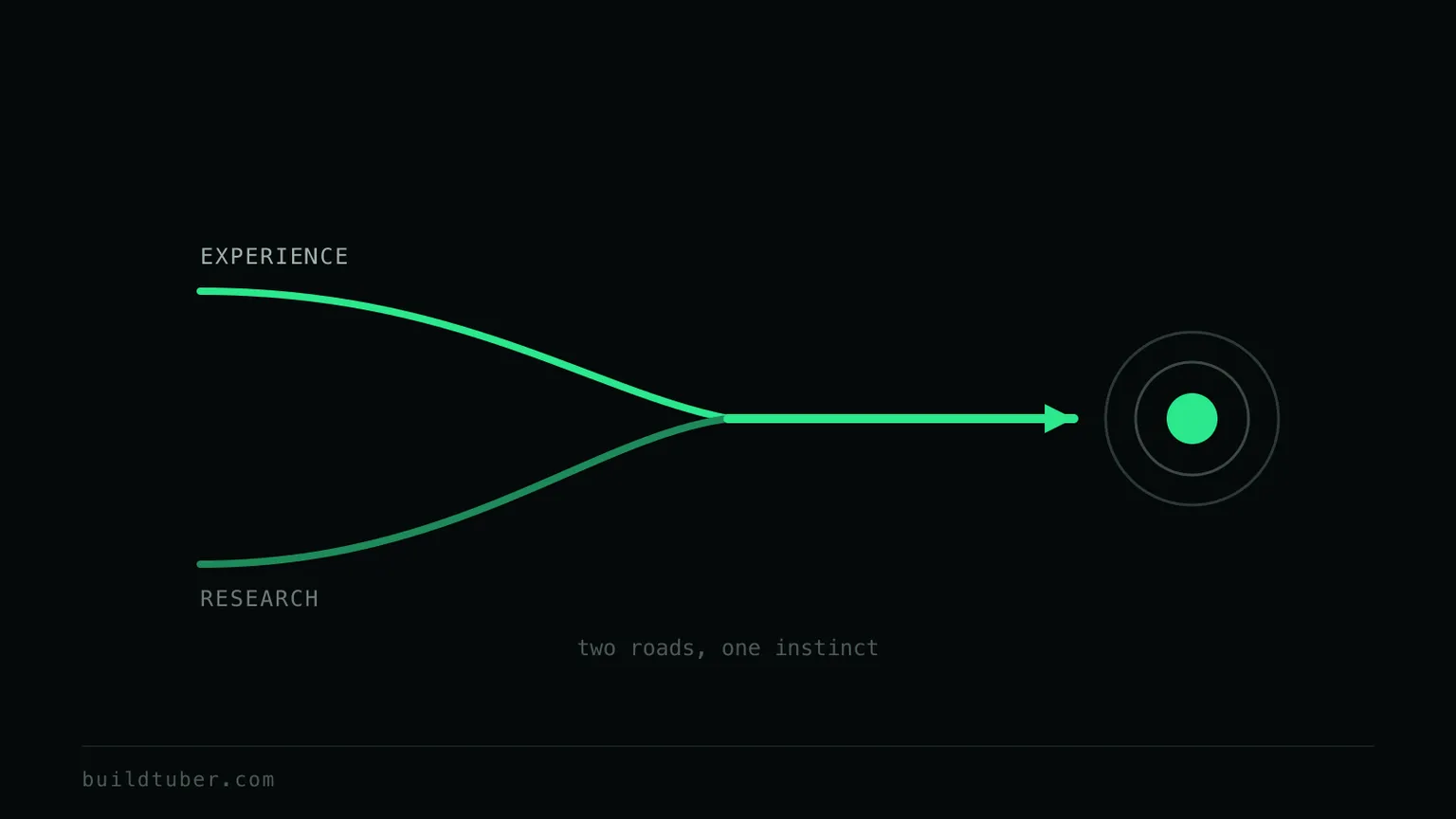
There are two routes to this level.
The first is experience. You know the topic and the audience so well that most decisions happen without deliberation. You have studied your winners against your failures and noticed the patterns. You know which hook structures create curiosity, where people usually leave, when the payoff has to land, which examples feel relatable, how long you can delay an answer before the audience gives up on you. You are not copying a formula off another channel any more. You built your own instincts by reading your own results.
The second is research. When you do not already understand the topic, you research until you do. The audience, the competing videos, their comments, Reddit threads, articles, papers, whatever people are actually arguing about right now. Find out what viewers already know, what they are tired of hearing, and what is missing. Then hand all of that thinking to the model instead of expecting it to find the angle by itself. Sometimes the research takes days. Some of it arrives in the shower. Write those down.
This post was written with the Level 4 method. I knew the subject from writing hundreds of scripts. I decided the core argument first, then mapped the levels, what each one is for, and the progression I wanted you to feel. Then I wrote it section by section rather than asking for the whole thing at once. I reviewed every draft, cut anything that sounded generic, added real examples and view ranges, rewrote weak transitions, and kept pushing until each section matched what I have actually seen. The model helped organise, sharpen wording and attack the weak parts. The structure, the examples and the final judgment came from me.
Level 5 - The Human
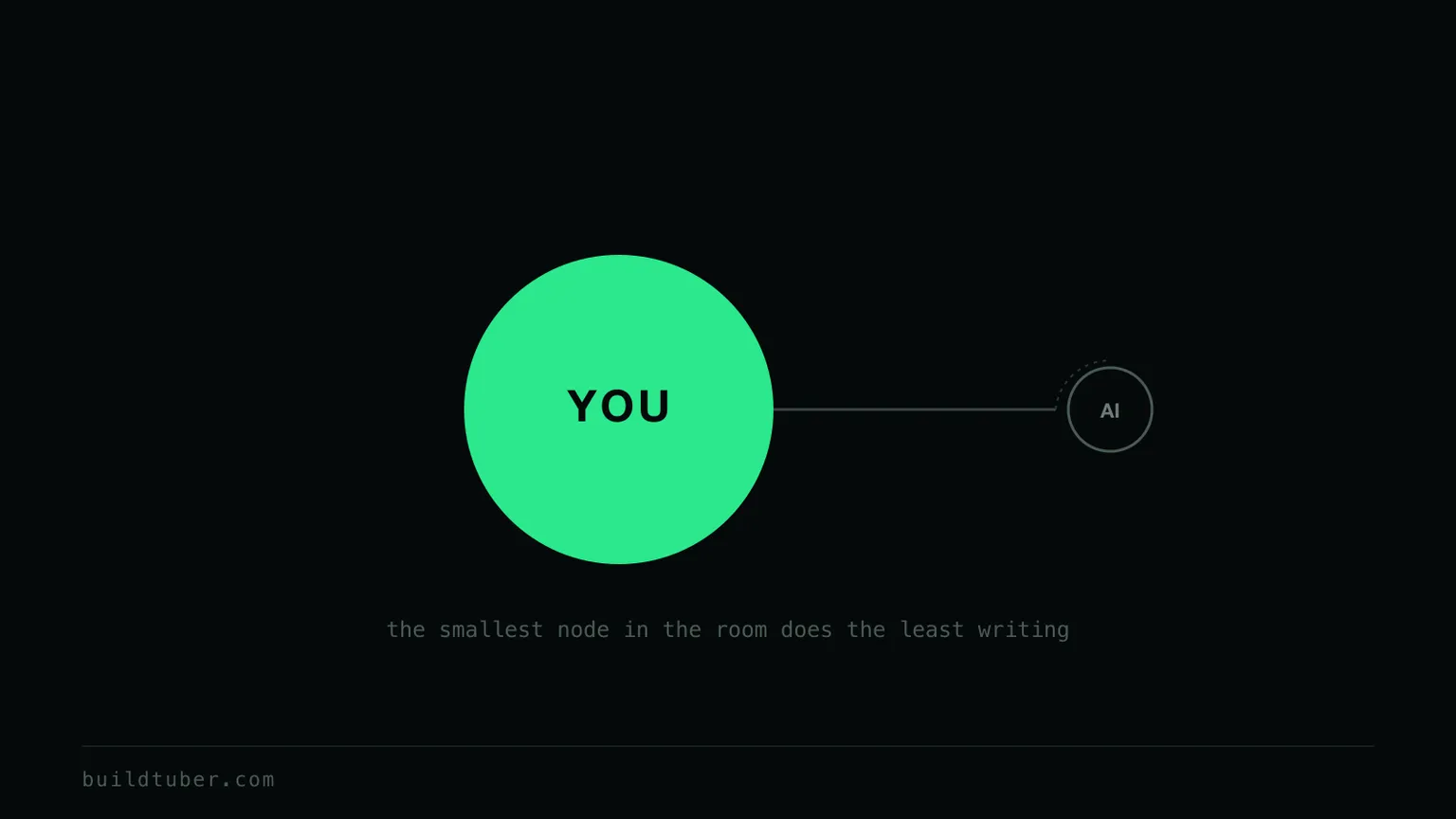
The highest level is the one where AI does the least writing.
For now, no model consistently beats a skilled human writer who deeply understands the audience, the topic, the timing, the humour, the tension and the payoff. A human can break a pattern on purpose, take a creative risk, put a personality on the page, and write something that feels alive rather than optimised.
At this level you write the script yourself and use AI only to attack weak sections, challenge your logic, suggest a better line or tighten the flow. The model may produce something technically cleaner. The human version is usually the one with a voice.
So which level are you on?
The honest answer for most people is somewhere between Level 2 and Level 3, with occasional visits to Level 4 when the topic happens to be one they already know well. That is fine. The ladder is not a ranking of people, it is a description of how much of the thinking you have taken back.
The only move that matters is the next one. If the model is still deciding what your video is about, take that decision back first. Everything else follows from it.
Frequently asked questions
Can an AI write a good YouTube script on its own?
Not reliably. Left alone it produces bland hooks, predictable structure and a script that reads fine and holds nobody. What it is very good at is executing a decision you have already made. The quality of the output tracks the quality of the thinking you hand it, not the quality of the prompt.
Which AI is best for writing YouTube scripts?
I use Claude for the writing itself because it holds a long, natural register better than the alternatives I have tried, and ChatGPT or Gemini to criticise the draft afterwards. But the model is the smallest variable here. Someone at Level 5 will beat someone at Level 1 on any model.
Is it plagiarism to rewrite a competitor's transcript with AI?
Rewriting a single transcript to understand the format is a learning exercise. Building a channel on it is a strategy with a ceiling, and a legal and policy risk you are carrying without noticing. The deeper problem is that you never learn to write, you only learn to rewrite.
Why do my AI scripts sound generic?
Almost always because the model is making decisions you should be making. Who the video is for, why anyone would click, what the viewer should feel in the first thirty seconds, how the story ends. If those are unstated, the model picks the statistically safe answer to each, and the safe answer is what everyone else got.
How do I stop the model from ignoring my script rules?
You mostly cannot, at the prompt level. A rule written into a prompt is a preference, and providers honour preferences inconsistently and change that behaviour between versions. If a rule genuinely must hold every time, it needs to be checked outside the prompt, by something that rejects a draft that breaks it.
Do I need an API key to write scripts this way?
No. Everything up to Level 4 works in a normal chat window. An API key starts to matter when the script gets long enough that it has to be generated in pieces, or when you are producing enough of them that a per-token bill beats a monthly subscription.
Related guides
- YouTube Growth7 min read
How to Start a Faceless YouTube Channel in 2026
After 1000+ published videos, the order I would actually follow: niche first, then ideas, packaging, script, voiceover, visuals and the edit.
- Cost & Economics9 min read
My 90-minute sleep documentaries cost under $1
A 15,000-word Claude script runs about $0.30 on my own key. The section-by-section workflow, the CapCut assembly, and how a YouTube video stays under $1.
- YouTube Growth6 min read
Why YouTube Automation Doesn't Work in 2026 (and What Actually Works)
YouTube automation is easier than ever in 2026, but production is no longer the advantage. Here is what actually matters for a faceless YouTube channel now.
Get the build guides as they go out.
One email when a new guide ships. The full method, not a teaser. Unsubscribe whenever.